You sit fingers knitted, your face pressing forward against them as your arms prop you up, elbows against the table in front of a large map. Communist influence is spreading faster than you’d like across Asia, and they seem to be making a play for North Africa earlier than expected. But you are calm. It may seem like their resources are endless, but you know no one can sustain that kind of pace indefinitely. All the while you have one eye on Europe. If it should fall, everything is lost. A regime change in the Middle East, you think, is just what is needed right now. If anything, it will distract your opponent long enough for you to contain this red mess spilling out over the world.
I will never turn down a game of Twilight Struggle. The mind games, the razor thin margins to cut in front of your opponent, messing with their plans, the thrilling turnabouts when you break their choke hold on a section of the board, no game for me comes close to that brain burning sense of satisfaction I garner from this game. But there’s a problem bigger than global thermonuclear war looming over this stretch of cardboard. The real problem isn’t outsmarting your play partner vying for world domination. It’s finding that play partner in the first place. Welcome back to my series: A Year of Living With My Library, a full year in which I play only the board games already on my shelves. If I’m going to dig in with what I’ve already got, I figured I should spend some quality time with one of my most beloved yet least played titles.
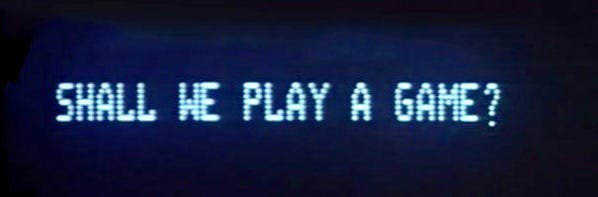
As a famous computer from an older movie once asked, “Would you like to play a game?
Rules Of Engagement
Twilight Struggle isn’t exactly a new game. In fact, it reigned on Board Game Geek’s #1 rated spot for years quite some time ago. By those standards, this game is practically ancient. As such, I will spare you a complete rules rundown. They exist everywhere you already look for board game rules online. Still, given the game’s age, and its arcane nature, a person could be forgiven for not knowing what this game is about. Here’s a quick brief to bring you up to speed.
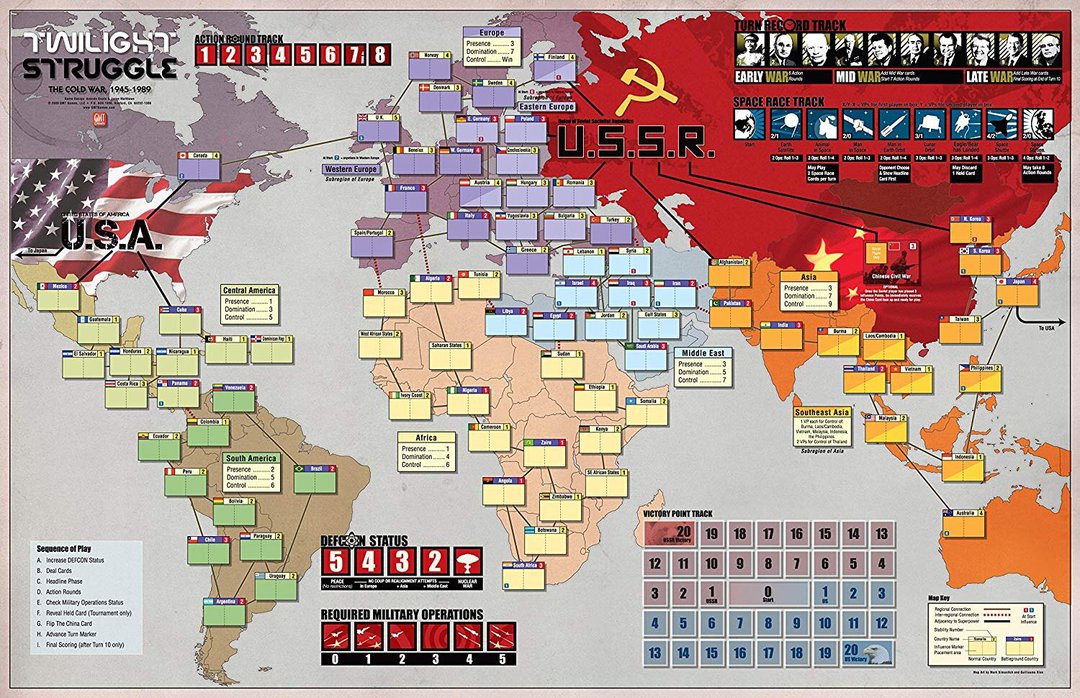
Exactly two players square off in this game of superpowers flexing their muscles at one another, one player taking the US while the other takes the USSR. There are a few actions in the game, but the one you’ll be doing ninety percent of the time is placing influence on the board to control the various countries spread across the map. The general aim is to have more countries aligned with your superpower in a region when score cards are played and points are awarded, especially the ones with fancy red borders around their names. You do this by playing cards from your hand. The catch? Both players draw their cards from a single deck, and cards are marked either US, USSR, or neutral. If you play a card belonging to your opponent, you still get to make your play, but you trigger the event on the card for your opponent. In a given turn (yes, this game flips what players traditionally use for round/turn, we just have to deal with it), you will play all but one card, barring a few ways to dump unwanted cards or hold onto an extra. Thus, the game becomes a battle not just of outmaneuvering your opponent but also trying to minimize that bad stuff in your hand, some of which you will be forced to give to your opponent. It’s okay. They’re trying their hardest not to do the same for you.
When I teach games, I often start with “this is how you win” as a means of framing my rules explanation. It contextualizes everything that follows in a way that means the most to folks who are going to play with me. I make an exception here. This is how you lose a game of Twilight Struggle. You lose if your opponent pulls the tug-of-war point slider all the way to its max of 20 in their favor. You lose if your opponent dominates all of Europe, the true Cold War endgame. And you lose if you cause global thermonuclear war. Well, I mean, technically everyone loses with that one, but you technically lose right before the nukes hit. Should the game go its full ten turns, all regions are scored one final time and that score determines the winner. There are some other clever ways to end the game, but these are the bare bones basics.
So go ahead and go wild! Forcefully change a few world regimes. Install some dictators. Be an absolutely scummy world superpower. Make your opponent’s finger inch ever closer to that little red button that starts World War 3. Just make sure they don’t actually press it. We wouldn’t actually want a real war on our hands, now would we? As long as we can rub their face in the dirt over us being better than them, that’s what really matters here.
The Hottest Cold War
In a lot of ways, I liken Twilight Struggle to Chess. Both are games with static boards that always start in the same position. They have predictable pieces that move in ways you can anticipate. You can study various openings and sets of moves in both games. Learning the rules to both is a relatively easy process, though mastering their finer points can take a lifetime of play. The difference, at least for me personally, is that despite the amount of Chess I played as a kid, I just never got into it. It never became about two armies locked in a master battle of wits, thinking several moves ahead, my mind in a quantum state like some people describe. Forgive me for saying it this way, but Chess was always just a bit boring. If you’re still reading after that last bit, then let me continue by saying Twilight Struggle, for all its similarities in structure, sidesteps all that with a solid theme that draws me in so much more.
There is an evolution within every game of Twilight Struggle that keeps me hooked. I look forward to it each time I play like a kid bouncing up and down in their seat, their favorite TV show about to start. The deck is split into three “phases,” with each phase shuffling in a new set of cards every few turns. In the early war, the USSR expands out seemingly without limit. It’s all the US player can do to contain the damage. In these early turns, it’s fun to see if you can force a surprise turn 2 or 3 victory, and it’s very satisfying when you do! When the mid war cards come into play, the US starts turning the tide. The USSR player now has to worry about losing some of their early holdings, but new score cards for the rest of the world regions come into play, the political battlefield getting much harder to track at a glance.
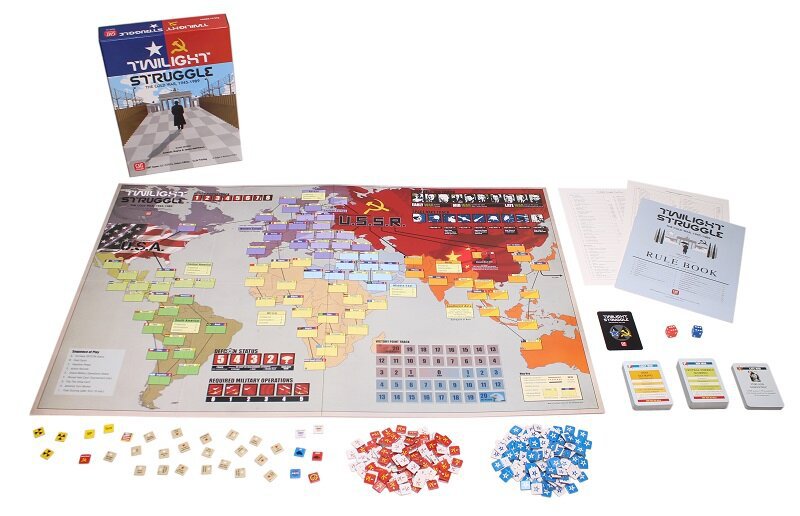
Originally published in 2005, it's production quality and how the board looks can be intimidating to many.
If either player hasn’t lost by this point, it’s entirely likely they could force an early victory themselves in the next couple turns. Then the late war hits. It’s time to lock down what you’ve got. Decide what’s worth fighting over and what’s just a tar pit to your resources. One of my favorite ways to win in this late stage is by the Wargames card, an ability that triggers final scoring immediately and gives you an automatic win if you have a certain margin of point lead when it’s done. “Bruh, if we actually fought a real war I would totally beat you!” There’s even an achievement in the app version of Twilight Struggle for winning this way. I live for this gameplay arc. Win or lose, every game of Twilight Struggle tells a story, and I’m always happy to shake hands with my opponent afterwards.
Would You Like To Play A Game?
Remember the start of this article? I mentioned that the hardest part about playing Twilight Struggle isn’t in its rules. Aside from having to read all the cards, and maybe eventually knowing them well enough to remember them, I maintain that the actual rules of this game are pretty simple. Play a card, spread some influence, score some points, try to watch out for events, and do occasional coups. Don’t worry about realignments. They always bite you in the butt anyway. Simple!
But just try sitting someone down to a 2+ hour board game, a hard enough sell as is, and before you start you have to drop terms on them like “DEFCON suicide,” show them specific early war cards like Blockade and Olympic Games (cards that can pretty much ruin you if you don’t know how they work in advance), and point at Iran on the first action round saying “just coup this, trust me,” (I always put new players on USSR when I teach, since they’re a bit easier in the early war). The rules might be simple, but using them to any decent effect is difficult difficult lemon difficult.
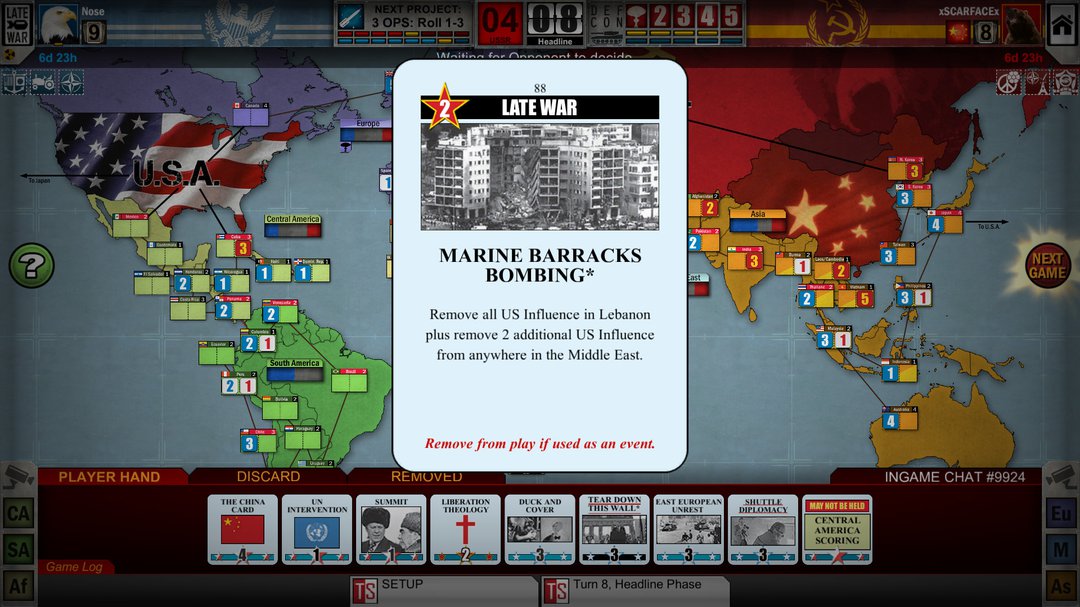
Taking a friend from trying this casually, humoring me by playing the neat looking cold war game, to having a serious play partner is another story altogether. That’s why, for years prior to my Year of Living With My Library, my only play partner has been the automated opponent in the Twilight Struggle app. For lack of anyone else to play with, I’d set up a game on my phone and lose horribly. But I’d learn by imitating what the computer did. I’d swap sides and try it in reverse only to lose horribly again. Learn, swap, repeat. Eventually, I managed to win my first game. And from there it was a quest to unlock every achievement on the app.
Win with each side. Check. Win by having the other player commit “DEFCON suicide,” that is putting them in a position where they lose the game by causing nuclear war. Check. Win within the first 3 turns. Check. Win after final turn 10 scoring. Check. Win with the Wargames card. Check, check, and so on. After some time, though, the appeal of playing against computer opponents lessened much like in my experience with 50 Day of Blazblue. There’s an online, asynchronous feature on the app, but board games just hit different for me compared to video games. Part of my love of this hobby is the real life connection it brings as you sit across a table with friends and family. As the saying goes, the object of the game may be to win, but the point of the game is to have fun. I wondered. Could I possibly train a play partner within my weekly board game group?
I’ve said it before, but it bears repeating. I’m sure every board gamer out there thinks they have the absolute best group, but I’m sorry to disappoint you all. My group is the real tops. Not only are they accepting, chill folks, but they’re also super willing to jump in on any copy of a game we’re reviewing, a fresh purchase, or just something a newbie has shown up to game night with tucked under one arm. They will play just about anything, laughing the whole time! You’d think that means it would be easy for me to find one person to play with. Even so, Twilight Struggle is a hard sell. The gritty, real world theme is off-putting to many. In our fairly large Wednesday gatherings, I found two who were interested in trying. Plus our writer Eric, though with him not living locally, we’d have to play via the app.
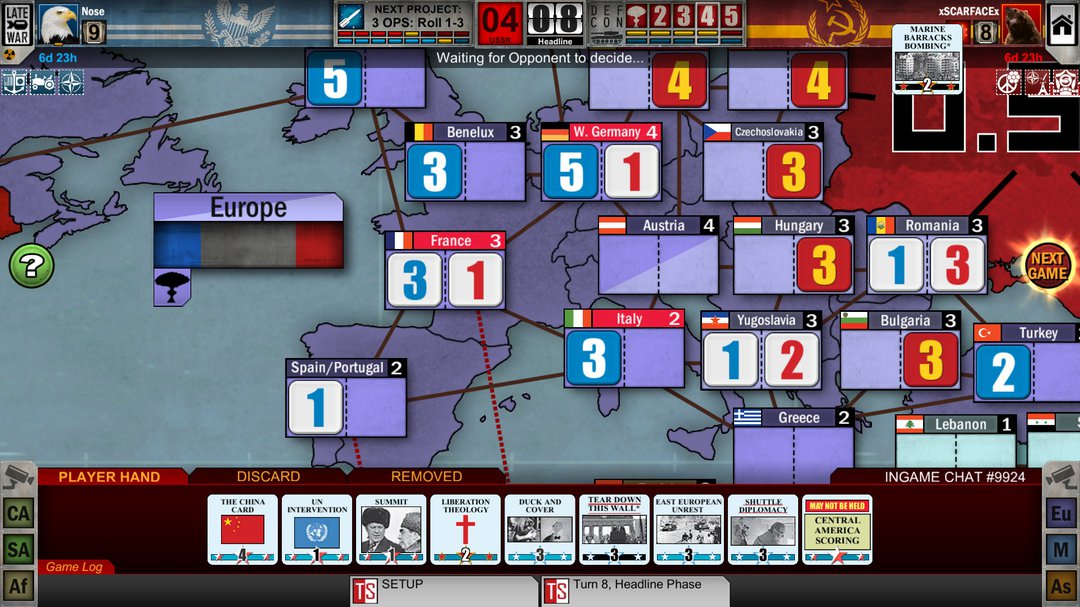
And here the hard reality settles in again. No one was willing to play on the app simply for the purpose of becoming more comfortable with the cards, in my opinion the number one impediment to fluid, quick play; nothing bogs down a new player like taking 5+ minutes every time they get a new hand to read every card they’re dealt. It would have to be in-person or nothing, and after a hard workday, or sometimes a hard work week, or work month, playing a chess-like brainer burner about the Cold War wasn’t high on my friends’ priorities over lighter, funnier, quicker titles. I can’t blame them. I keep saying how Twilight Struggle is a big ask because it is. The payoff, the poetry of this game, is matched by few titles in my library, but the justification of “just put 10 more hours in bro, I promise it gets good” has never been a good argument. I’ve never done that to friends and I’m not about to start now. There was curiosity, yes, but dedication? A glimpse of glimmering goodness awaiting on the other side? I think in that respect I was alone.
Transcendent Gaming
Paraphrasing Rutger Hauer’s famous speech from Blade Runner, “I’ve seen things you people wouldn’t believe.” Korea united in the late 1940s. A surprise brush war that breaks all of Europe. All those moments will be lost, like unplayed games on Kallaxes. The beauty of Twilight Struggle comes in the subtle moments between plays, a nudge of influence that allows a break through previously impenetrable lines. The decision to abandon an entire continent to focus your gambit elsewhere, only to return three turns later, when your opponent has all but forgotten you’d even consider fighting there, to endanger their entire grasp of it. Playing the most desperate hand of your life, every single card having your opponent’s marking on it (giving them every event), knowing soon either they will be dealt a similar hand or you will have a perfect one of your own to follow up with.
These are not things that you can tell someone about. Knowledge lived is different from knowledge given. They’re discoveries that reveal themselves after dozens of plays. Despite its static start, Twilight Struggle is such a dynamic game that it always takes on its own life. No two games are ever quite identical for me. And in that liminal space between the moves, a conversation develops. It’s similar to the feeling I get from fighting games. The dance between play partners is something I get from this game unlike any other title in my library.
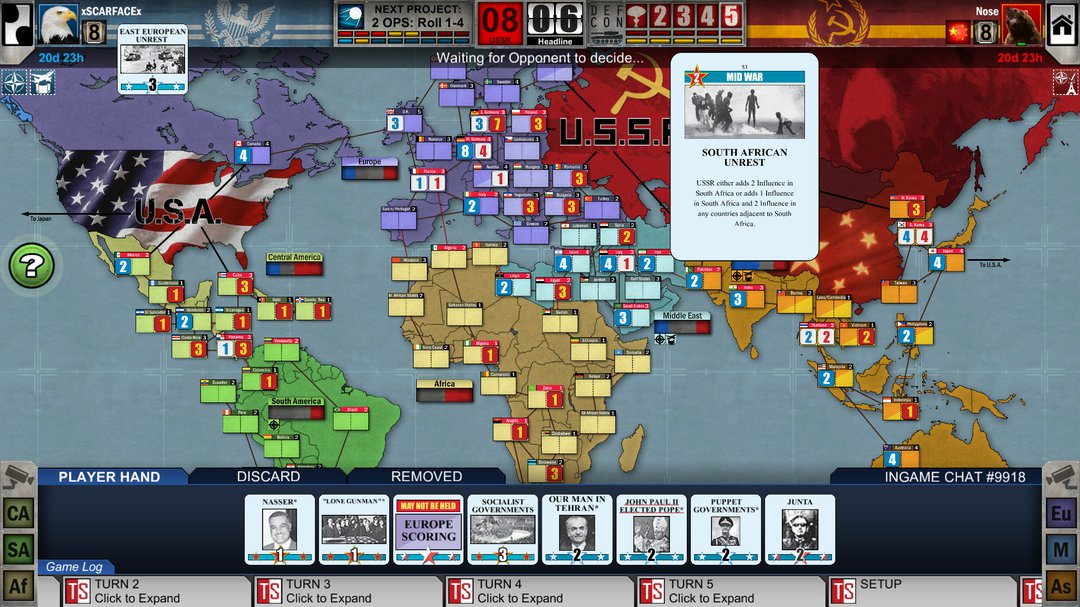
Twilight Struggle is a masterclass of a board game, and while I’m sure you can make this case for many titles in our hobby, for me it remains one of the all time greats for a reason. My lament lies not with the desire to find the perfect play partner to split wits with, though that would be nice. It is that the beauty I see in this game is one I may never truly be able to share. For even just one friend to see this game the way I do, to feel the grace in the card plays as we dance together on the board, would bring me the greatest happiness.
Another reviewer friend once said to me that for all the good games that come out every year, of which there are more and more, there are still only ever a few truly great ones. That this game has proven itself so many years ago already, and continues to stand tall, yet unknown to anyone I play with, is something I’ve come to accept. I have experienced this game, and that is no small thing. And even if I am alone in these feelings, I know that somewhere out there in our hobby there are others who have looked into the depths, who possibly share their love of them with at least one other person, who know the joy that I’m alluding to here. Who have done what I could not. Treasure each game you play. Together, you have touched something both elusive and wondrous.
